
In August 2026, the Asia-Pacific semiconductor equipment materials market will reach a critical turning point. The surge in demand for storage chip equipment driven by AI, and breakthroughs in HBM technology, are reshaping the industry landscape. This article provides an in-depth analysis of the latest developments in equipment materials, including the expansion trend in Southeast Asia, the impact of technological iteration on the supply chain, and key areas for investors to focus on.
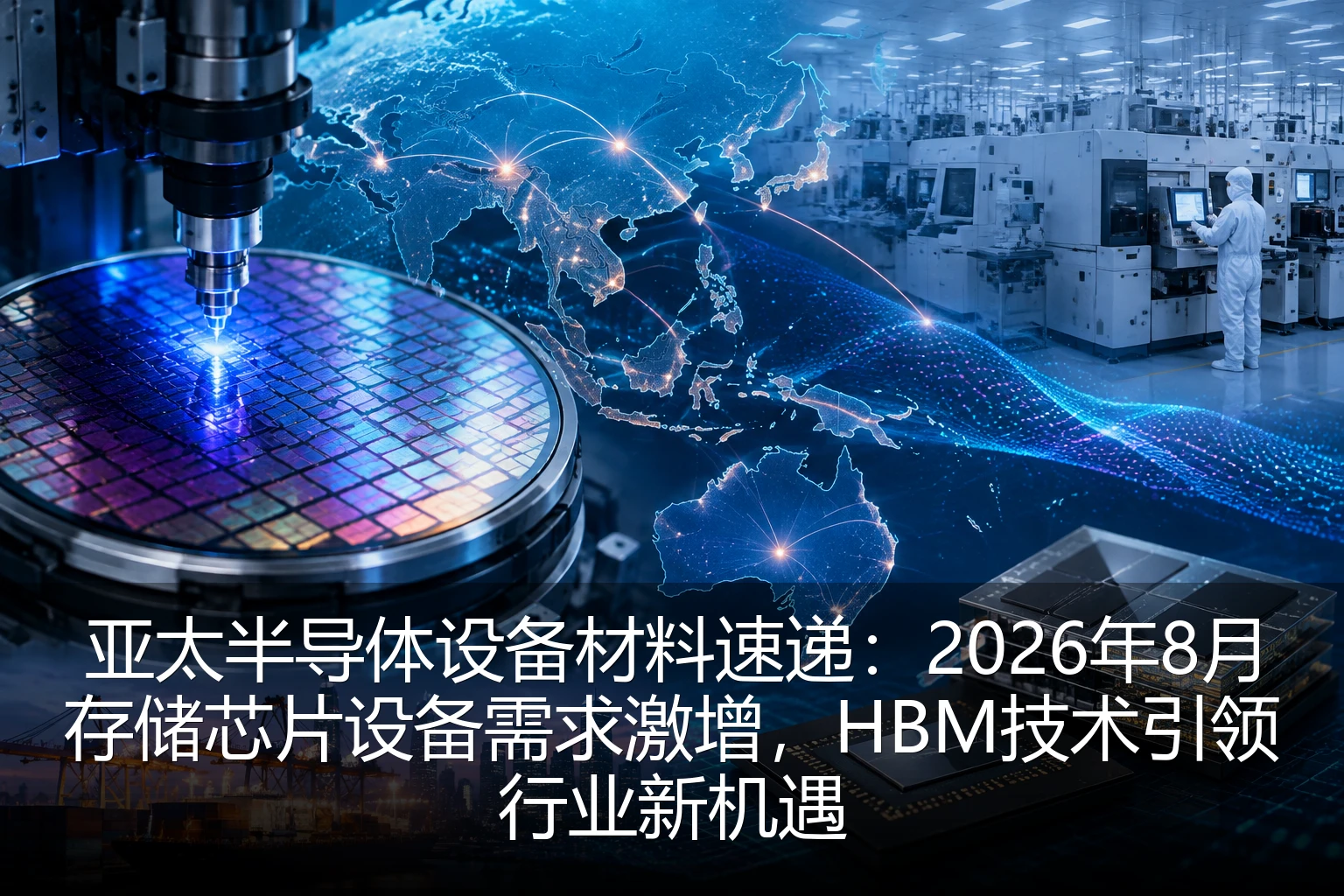
In August 2026, the Asia-Pacific semiconductor equipment and materials market is undergoing a profound transformation driven by AI demand. With the explosive growth of generative AI and large language models, the demand for storage chip equipment is surging, with equipment related to High Bandwidth Memory (HBM) becoming the market focus. This article will analyze the supply and demand landscape, technological breakthroughs, and investment opportunities in the Asia-Pacific semiconductor equipment and materials sector, providing decision references for investors.
## Market Overview: Increased Equipment Demand, HBM Leads Growth
Currently, the global semiconductor industry is shifting from traditional cyclical recovery to AI-driven structural growth. In the Asia-Pacific region, especially in South Korea, Japan, Taiwan, and Southeast Asian countries, the storage chip equipment market is particularly prominent. According to industry data, in the second quarter of 2026, Asia-Pacific semiconductor equipment orders grew by 35% year-on-year, with storage chip equipment accounting for up to 40%. This growth is mainly driven by the surging demand for high-performance storage from AI servers, especially the widespread adoption of HBM technology.
HBM, as a core component of AI computing power, is seeing continuous demand increases in 2026. Market research institutions predict that the global HBM market size will reach $15 billion in 2026, with a compound annual growth rate exceeding 50%. This trend directly drives demand for related equipment, including wafer fabrication equipment, packaging and testing equipment, and material supply. In the Asia-Pacific region, Korean and Japanese companies hold dominant positions due to their technological advantages, while Southeast Asian countries are actively capturing market share through expansion plans.
### Technological Breakthroughs: HBM4 Mass Production, Accelerated Equipment Iteration
Technological breakthroughs are key factors driving equipment demand growth. In August 2026, several semiconductor giants announced significant progress in HBM4 technology. For example, SK Hynix and Samsung Electronics, after obtaining NVIDIA certification, have HBM4 products that offer a 30% performance improvement and a capacity increase to 24GB, meeting the demands for higher bandwidth and lower power consumption from AI servers. These technological breakthroughs not only enhance storage chip performance but also prompt equipment manufacturers to accelerate production line upgrades.
At the equipment level, companies such as Applied Materials and Tokyo Electron have launched advanced packaging equipment supporting HBM4 mass production. These equipment utilize new material deposition techniques and high-precision lithography processes, capable of handling more complex stacking structures. Simultaneously, equipment manufacturers are collaborating closely with chip manufacturers to optimize production processes to address yield challenges in HBM production. For instance, Micron Technology recently announced an 80% yield breakthrough for HBM3E, thanks to improvements in process control by equipment suppliers.
### Regional Dynamics: Southeast Asian Expansion Wave, Acceleration of Equipment Material Localization
The Southeast Asian region is becoming a new hotbed for global semiconductor equipment and material investment. In 2026, countries such as Malaysia, Vietnam, and Singapore are introducing policies to attract semiconductor companies for investment. For example, the Malaysian government launched the "Semiconductor Industry Upgrade Program," offering tax incentives and infrastructure support to attract equipment giants like Tokyo Electron and Dtec to establish local plants. Dtec has set up a cutting equipment production base in Malaysia to meet advanced packaging demands. Singapore leverages its technological hub advantage to attract R&D centers from equipment manufacturers such as ASML. ASML established its technology center in Malaysia in July 2026, focusing on R&D for advanced packaging and HBM production equipment. These initiatives not only promote equipment localization but also drive the improvement of material supply chains. For example, companies such as Shin-Etsu Chemical of Japan and SK Materials of South Korea are expanding their material capacity in Southeast Asia to support the needs of local equipment manufacturers. Furthermore, China and Taiwan are accelerating innovation in equipment materials. Foundry companies like TSMC and United Semiconductor are investing in advanced packaging equipment to support HBM and 3D NAND production. In 2026, TSMC announced the introduction of new packaging equipment in its Nanjing facility to enhance HBM capacity, with projected double capacity in 2027.
### Investment Opportunity Analysis: Leading Equipment Material Stocks Show Strong Performance
In the US stock market, leading semiconductor equipment material stocks are performing well. In August 2026, application materials stock prices rose 12%, mainly benefiting from the surge in orders for memory chip equipment. Tokyo Electron stock also rose 8%, driven by strong demand for its advanced packaging equipment. Furthermore, HBM concept stocks such as SK하이닉 ADR and Samsung Electronics ADR continued to strengthen, rising 7% and 5% respectively, reflecting optimistic market expectations for AI storage demand. Looking at capital flows, north-bound funds and cross-border ETFs continue to increase investment in the semiconductor equipment material sector. In July 2026, semiconductor equipment ETFs saw an inflow of $2 billion, with the Asia-Pacific region-related ETFs accounting for over 60%. Investors should focus on leading companies with technological advantages and regional layouts, such as Application Materials, Tokyo Electron, and ASML, as well as HBM suppliers like SK하이닉 and Samsung Electronics.
### Future Outlook: Technological Iteration and Capacity Expansion Go Hand in Hand
Looking ahead, the Asia-Pacific semiconductor equipment material market will continue to benefit from the growth in AI demand and technological iteration. HBM5 technology is expected to achieve mass production in 2027, further driving equipment upgrades. Simultaneously, Southeast Asian expansion plans will create significant equipment demand, bringing opportunities to local supply chains. However, challenges cannot be ignored, including supply chain risks, shortage of technical talent, and geopolitical influences. Overall, in August 2026, the Asia-Pacific semiconductor equipment material market is on a fast growth track, with HBM technological breakthroughs and regional expansion creating new momentum for the industry. Investors need to closely monitor technological progress, capacity expansion, and changes in market demand to seize investment opportunities.