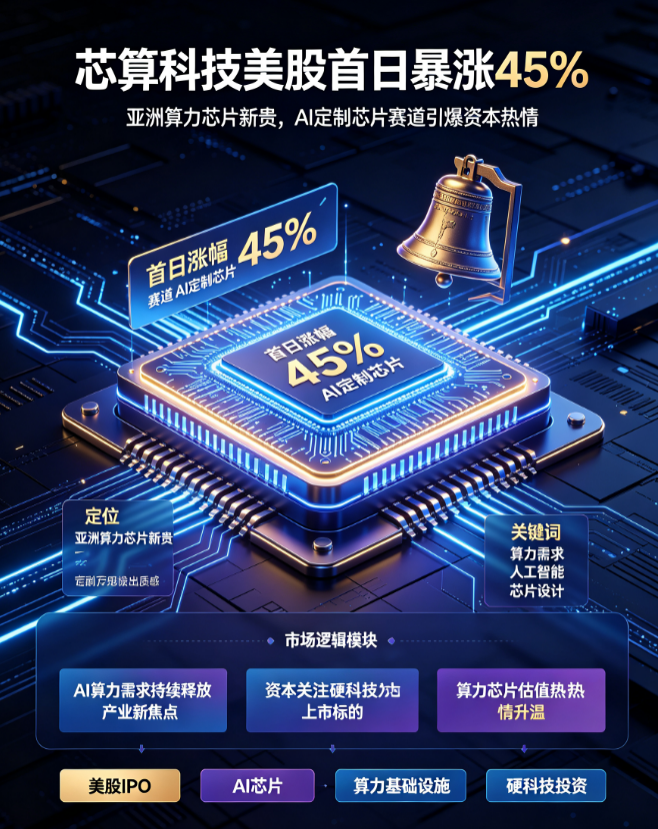
Rocketing Debut: ChipSwift Rewrites Asia Chip IPO Record
On July 28, 2026, ChipSwift Technologies (stock code CST), a Singapore-based AI chip design company, listed on Nasdaq. The stock opened 38% above the $32 offer price, traded high all day, and closed at $46.40, up 45%. At the closing price, market cap reached $12.35 billion, setting the highest first-day gain for any Asian semiconductor company IPO in the U.S. this year.
The IPO offered 25 million ADSs, raising $800 million, with oversubscription of 21 times. Underwriters include Goldman Sachs, Morgan Stanley, and UBS; the greenshoe option was fully exercised. ChipSwift's core product is the SwiftCore-1, a custom ASIC for LLM inference, offering 3.2x energy efficiency over NVIDIA H100 with 40% lower power consumption. Founder and CEO Chen Mingyuan said at the bell-ringing, 'Our goal is to provide the most cost-effective inference compute for global AI cloud providers, making large model deployment no longer constrained by high chip costs.'
Inference Demand Explodes, ASIC Replaces GPU as New Trend
ChipSwift's surge is not isolated. Since 2026, with GPT-5, Claude-4 and other massive models in production, AI inference compute demand has grown exponentially, while GPU cost disadvantages for inference become clear. IDC's latest report shows global AI inference chip market reached $17.8B in Q2 2026, with ASIC share jumping from 12% to 29%, expected to surpass GPU as the largest segment by 2027.
'The industry relied too heavily on NVIDIA GPUs, but dedicated architectures bring 10x+ efficiency in deployment,' said Li Min, semiconductor analyst at Morningstar Capital. 'ChipSwift sits at the inflection point from training to inference, and its team from Broadcom and MediaTek brings advanced packaging and chiplet design expertise, key barriers for investors.' ChipSwift's products are already adopted by Southeast Asian cloud leader GrabCloud and e-commerce platform Tokopedia. According to its prospectus, H1 2026 revenue reached $245 million, up 410% YoY, with gross margin above 68%.
Asia Chip Firms Accelerate US Listings amid US-China Tech Dynamics
ChipSwift's IPO is the latest in a wave of Asian semiconductor companies listing in the U.S. this year. According to Nasdaq data, seven Asian chip firms (five headquartered in Singapore, Taiwan, and South Korea) have listed in 2026, raising over $4.6 billion combined, far exceeding last year's $1.9 billion. These companies focus on advanced nodes, HBM, chiplet packaging, and AI custom chips.
Notably, despite tightened U.S. chip export controls on China, Singapore and Malaysia-based chip design firms are not directly restricted, acting as a 'buffer zone' in the US-China tech competition. SEC Chair Gary Gensler stated in May he welcomes 'Asia chip companies that pass national security review' to list in the U.S., opening the door for firms like ChipSwift.
'ChipSwift's IPO is not just a company's success – it signals a shift from unipolar to multipolar global compute supply chains,' said Prof. Lin Weiqiang of Nanyang Technological University. 'Over the past two years, geopolitical fragmentation of Asia supply chains has spawned many local innovations, now gaining global capital recognition via U.S. listings.'
Risks: Capacity Constraints and Customer Concentration
Despite strong debut, ChipSwift faces challenges. The prospectus discloses that all wafer orders are placed with TSMC; tight advanced-node (5nm and below) capacity may affect H1 2027 deliveries. In addition, its top two customers GrabCloud and Tokopedia account for 62% of revenue, posing concentration risk.
International competitors are catching up. NVIDIA plans a custom inference-optimized version by end of 2026, while AMD's MI400 series adds inference acceleration. Whether ChipSwift can maintain its tech lead amid giants remains to be seen.
Outlook: Inflows into Chip ETFs, Thematic Fund Weightings Surge
ChipSwift's surge lifted the broader Asia chip sector. Today, the PHLX Semiconductor Sector Index rose 2.3%, with TSMC up 1.2% and MediaTek up 3.5%. Reports indicate multiple Wall Street quant funds increasing bets on AI inference chip themes; the Asia component weight in ETFs like VanEck Semiconductor ETF (SMH) reached 34%, an all-time high.
For cross-border investors, ChipSwift again proves that Asia chip firms with proprietary tech advantages can still command high premiums on U.S. markets. But before chasing, fully understand their technology roadmap and customer stickiness. In coming months, at least three more Asia ASIC design firms are expected to file for U.S. IPOs, making this track one of the most crowded in U.S. tech listings.