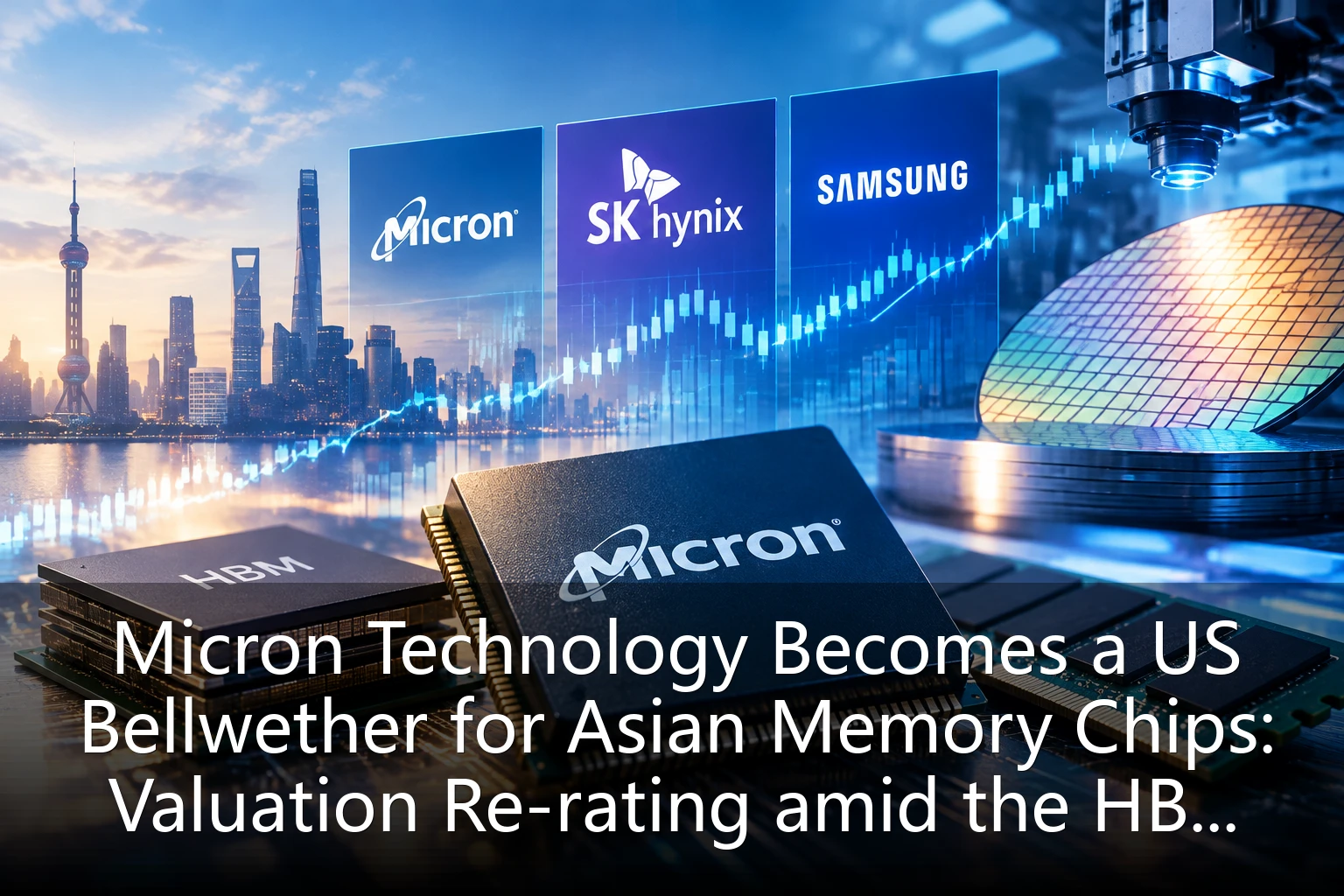
As the AI memory supercycle continues to unfold, Micron Technology is becoming a unique window for global investors to gauge the health of the Asian memory chip supply chain. Unlike Samsung Electronics and SK Hynix, which trade in the US as ADRs, Micron is one of the few domestic pure-play memory stocks in the US market. Its share price, earnings guidance, and capex cadence are often treated by investors as a key reference for pricing Asian memory chip ADRs. Entering Q4 2026, as the intensifying HBM race intertwines with a recovering DRAM price cycle, the correlation and divergence between Micron and the two Asian memory giants are reshaping the valuation logic of the US memory sector.
Micron: The US Market Mirror of the Asian Memory Landscape
The global competitive landscape of the memory industry has long been dominated by three players: Samsung Electronics, SK Hynix, and Micron Technology. For US investors, SK Hynix and Samsung Electronics trade primarily via ADRs, with liquidity and disclosure cadence that differ from their home markets; Micron, as a native US-listed company, offers more transparent and frequent earnings disclosures and guidance. This structural difference makes Micron's earnings season a high-frequency window for validating DRAM and NAND price trends—when management gives directional calls on server DRAM, HBM, and enterprise SSDs, the market typically quickly maps them into the pricing of Asian memory chip ADRs.
From a supply chain perspective, Micron's positioning is also distinctive: it is deeply engaged in high-end AI memory competition such as HBM while maintaining a full portfolio across traditional DRAM and NAND. Its advanced DRAM fabs in the US and packaging and testing capacity across Asia form a cross-regional supply chain network, making its earnings elasticity a sensitive gauge of the memory cycle's temperature.
The HBM Race: Three-Way Positioning and Share Rebalancing
HBM is the core incremental battleground of this memory supercycle. The industry's prevailing competitive dynamic: SK Hynix stays ahead on first-mover advantage, Samsung Electronics is accelerating its catch-up to rebuild customer trust, and Micron is gaining share with a more aggressive capacity expansion pace. As AI accelerator iterations demand higher bandwidth and capacity, qualification and mass-production ramp of the HBM4 generation have become key variables determining the three majors' revenue mix over the next two years.
For Asian memory chip ADRs, the significance of the HBM race lies not only in share itself but in the re-rating of order visibility and earnings quality. HBM uses a deeply customer-integrated sample qualification model; once qualified by leading AI chipmakers, suppliers often lock in multi-quarter long-term orders, significantly improving the earnings volatility that memory makers have long been criticized for. Differences among the three majors in HBM4 qualification progress, ramp speed, and long-term contract pricing power will directly determine how widely their ADR valuations diverge.
Advanced Packaging and Capacity Bottlenecks
HBM's supply bottleneck lies not only in DRAM wafer capacity but also in TSV, stacking, and advanced packaging. The scarcity of packaging capacity imposes hard constraints on HBM delivery schedules, which is why all three memory majors are making large incremental investments in packaging. For investors, tracking the pace of packaging capacity expansion is a better predictor of HBM revenue recognition than wafer starts alone.
The DRAM Price Cycle: From Restocking to Structural Shortage
Alongside the HBM growth narrative, the price cycle of conventional DRAM is also entering an upswing. This round of price increases has clear structural features: demand for high-capacity DDR5 memory from AI servers keeps expanding, while major vendors tilt advanced capacity toward HBM, passively narrowing conventional DRAM supply growth and accelerating the exit of mature-node products such as DDR4—supply and demand are resonating on both ends. On the NAND side, spillover demand for enterprise SSDs from AI inference data lake construction is also supporting flash prices.
This structural shortage is being reflected quarter by quarter in memory makers' gross margins through contract price negotiations. As the easiest US-listed stock for investors to track, Micron's disclosures on DRAM average selling price changes and weeks of inventory are often used to calibrate expectations for Samsung Electronics and SK Hynix results, in turn influencing short-term fund flows into Asian memory ADRs.
Valuation and Fund Flows: From Cyclical to Cyclical-plus-Growth
The market historically priced memory stocks within a cyclical framework: high elasticity during price upcycles, rapid de-rating during downturns. But the structural shift in AI memory demand is pushing US investors to re-rate memory assets with a combined cyclical-plus-growth framework—companies with a higher share of HBM long-term contract revenue and a higher-quality customer base are more likely to sustain valuation premiums.
Under this framework, the valuation linkage between Asian memory chip ADRs and Micron is showing new characteristics: when evidence of an upcycle is first validated by Micron's earnings, SK Hynix and Samsung Electronics ADRs often catch up or accelerate; when the three majors diverge in HBM qualification progress, the gap in ADR performance widens markedly. This linkage structure—Micron as the anchor, Asia diverging—is one of the main threads of Q4 trading in the memory sector.
Signals to keep tracking include: the three majors' quarterly capex guidance, qualification progress on new HBM generations, quarter-over-quarter changes in DRAM and NAND contract prices, and enterprise orders as a share of total revenue. Together, these indicators will determine whether this memory cycle can upgrade from price recovery to a systematic lift in the earnings center.
Risk Warnings
- If AI infrastructure capex slows in pace, HBM order visibility could shrink;
- Intensified HBM4 competition among the three majors could constrain long-term contract pricing and gross margin elasticity;
- Weak consumer electronics end demand could drag on price recovery in NAND and niche DRAM;
- Geopolitical and currency volatility could amplify premiums and discounts of Asian memory ADRs relative to US listings.
Overall, the mapping between Micron Technology and Asian memory chip ADRs is evolving from simple synchronized rises and falls toward granular pricing based on HBM positioning and earnings quality. For investors focused on Asian semiconductor opportunities in US markets, understanding the cycle signals in Micron's earnings and cross-checking them against SK Hynix's and Samsung Electronics' qualification progress and capacity layouts will be the key methodology for capturing the Q4 memory sector move.