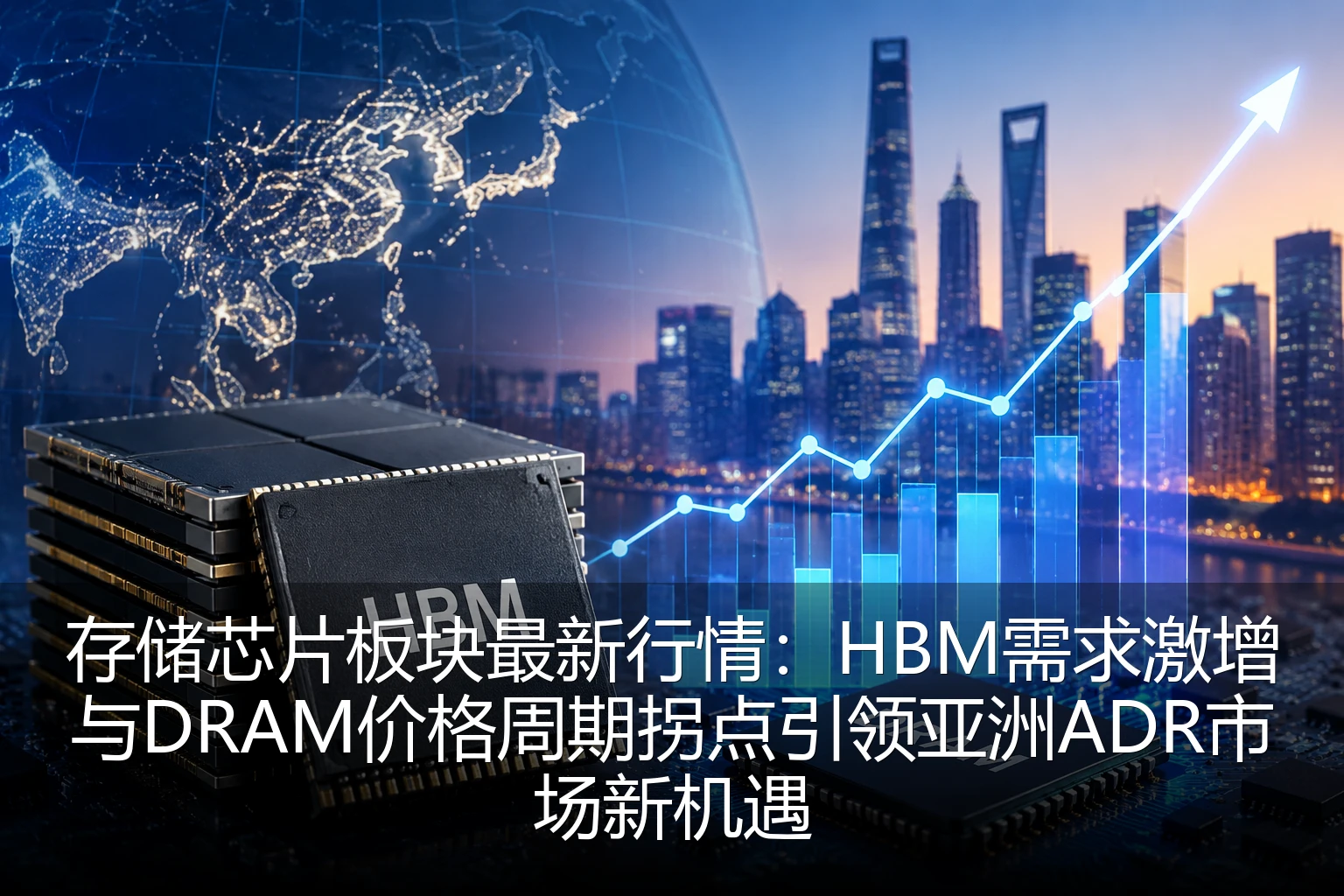
Storage Chip Sector Latest Market Trends: HBM Demand Surge and DRAM Price Cycle Turning Point Lead New Opportunities in Asian ADR Market
In August 2026, the global semiconductor industry is undergoing a profound transformation driven by Artificial Intelligence (AI), and the storage chip sector, as a core component, is demonstrating unprecedented vitality. With the explosive growth in AI applications, especially the increased demand for High-Performance Computing (HPC) and data centers, the storage chip market is entering a super cycle. This article will delve into the latest market trends in the storage chip sector, focusing on the surge in HBM (High Bandwidth Memory) demand, the turning point in the DRAM price cycle, and the market performance of Asian storage chip ADRs (American Depositary Receipts), providing investors with comprehensive analysis and forward-looking insights.
I. Surge in HBM Demand: The Storage Revolution in the AI Era
High Bandwidth Memory (HBM), as a critical component for AI servers and supercomputers, is experiencing soaring demand in 2026. With its superior bandwidth and energy efficiency, HBM is the ideal choice for training and inference of AI models. As major chip giants like NVIDIA and AMD continuously launch new generations of AI chips, the demand for HBM is growing exponentially. Industry analysis suggests that the global HBM market size is projected to reach hundreds of billions of dollars in 2026, with a compound annual growth rate exceeding 30%.
Among Asian storage chip companies, SK Hynix and Samsung Electronics are the main drivers of HBM technology. SK Hynix has secured certifications from NVIDIA for its HBM4 technology breakthrough, which will bring them a large number of orders. Samsung Electronics is also accelerating HBM4 R&D, planning to relocate some production lines to Austin, USA, to address geopolitical risks and market demand. This technological competition not only drives advancements in storage chip technology but also reshapes the market landscape of Asian storage chip ADRs.
Looking at capital flows, HBM concept stocks perform strongly in the US stock market. SK Hynix ADR recently set a new historical high, while Samsung Electronics ADR is relatively weak due to its traditional business drag. This polarization reflects the market's preference for AI storage demand, with investors leaning towards companies with technological leadership.
II. DRAM Price Cycle Turning Point: Supply and Demand Dynamics Reshape the Market
DRAM, another important category of storage chips, is experiencing a significant turning point in its price cycle in 2026. After several years of price declines, DRAM contract prices have risen in two consecutive quarters in the second quarter of 2026, marking a recovery in the storage cycle. This change is mainly due to the strong growth in AI and automotive electronics demand, as well as manufacturers' production curtailment measures.
The rise in DRAM prices has a positive impact on Asian storage chip ADRs. The ADRs of SK Hynix and Samsung Electronics showed strong performance in their earnings seasons, especially as SK Hynix raised its Q3 guidance for NAND flash memory business significantly, triggering a jump in US stock ADRs during after-hours trading. Micron Technology also experienced collective volatility in its ADR due to the yield breakthrough of 80% for HBM3E. These signs indicate that the storage chip industry is moving from an inventory adjustment phase into a demand-driven new cycle.
However, the recovery in the DRAM market is not without challenges. Inventory adjustment signals are emerging, and the shipment volume and price indices for Samsung and SK Hynix ADRs are diverging. Some analysts believe that although short-term demand is strong, the storage chip industry still faces the risk of overcapacity in the long term. Therefore, investors need to closely monitor supply and demand dynamics to seize market opportunities.III. Asian Storage Chip ADR Market Performance: Market Leaders Lead the Trend
SK Hynix and Samsung Electronics are the two leaders in the Asian storage chip ADR market. SK Hynix ADR showed outstanding performance recently due to HBM4 production certification and visibility of AI storage orders extending to 2027, with a gain exceeding 7% in the past week. In contrast, Samsung Electronics ADR was hampered by drag from traditional businesses and showed relatively flat performance. This differentiation highlights the strategic differences between companies in the AI storage sector.
Besides the market leaders, other storage chip ADRs are worth watching. Micron Technology, as a giant in US storage, saw market attention as news of an 80% yield breakthrough in HBM3E triggered a collective movement in ADRs. Furthermore, the stop and rise in NAND flash memory prices has injected confidence into the storage chip sector. With the co-rise of AI and production cuts, a new storage recovery cycle is beginning.
Looking at capital flows, the storage chip sector has attracted a large amount of investor attention. Six investment banks collectively view SK Hynix ADR positively, signaling a revaluation in the storage super cycle. ETF markets also showed a mild rebound, revealing structural opportunities. These signs indicate that the storage chip sector is becoming a hot spot in the capital market.
IV. Technological Breakthroughs and Capacity Layout: The Key to Future Competition
Technological breakthroughs are the core driving force for the continued development of the storage chip industry. Competition is particularly fierce between SK Hynix and Samsung Electronics in HBM technology. SK Hynix's HBM4, certified by NVIDIA, offers a 30% performance improvement, accelerating AI storage deployment. Samsung Electronics plans to move its HBM4 production line to the US to cope with changes in the global storage industry chain.
In terms of capacity layout, Southeast Asia is becoming a new hot spot for global semiconductor investment. Tokyo Electron invested $5 billion in a factory in Malaysia, ASML established a technology center in Malaysia, and Panlin Group set up an advanced packaging R&D center in Penang. These moves are accelerating the localization of Asia-Pacific semiconductor equipment and materials, providing support for storage chip capacity expansion.
In the advanced packaging field, Dtecco set up in Malaysia is betting on the Southeast Asian advanced packaging trend. This capacity transfer not only reduces production costs but also enhances supply chain resilience. For investors, paying attention to companies' capacity layout in Southeast Asia will help grasp industry trends.
V. Investment Opportunities and Risks: Viewing Market Volatility Rationally
The super cycle of the storage chip sector brings rich opportunities for investors. The surge in HBM demand, the turning point in DRAM prices, and the strong performance of Asian storage chip ADRs all provide good investment opportunities for investors. However, market volatility cannot be ignored.
Firstly, technological risk is the main challenge. Rapid iteration in HBM technology requires companies to continuously invest in R&D, otherwise they may be surpassed by competitors. Secondly, geopolitical risks affect supply chain stability, such as Samsung Electronics moving its HBM4 production line to the US, reflecting the company's strategy for dealing with geopolitics. Furthermore, changes in inventory cycles and supply-demand dynamics can lead to market fluctuations.
For investors, it is recommended to focus on companies with technological leadership and reasonable capacity layout, such as SK Hynix and Samsung Electronics. Simultaneously, diversify investments across different storage types (HBM, DRAM, NAND) and regions to reduce risk. In the long term, the continued growth in AI storage demand will bring long-term value to the storage chip industry.
VI. Conclusion: Market Outlook under the Storage Chip Super Cycle
In August 2026, the storage chip sector is at the start of a super cycle. The surge in HBM demand, the turning point in DRAM prices, and the strong performance of Asian storage chip ADRs collectively form the main theme of industry development. The strategic competition between leading companies such as SK Hynix and Samsung Electronics will determine the future market landscape. Despite market fluctuations and risks, the rapid development of AI technology provides strong growth momentum for the storage chip industry. Investors should view market volatility rationally, focus on technological breakthroughs and capacity deployment, and seize this historic opportunity. As the application of storage chips deepens in areas such as AI and automotive electronics, the industry outlook is broad, warranting long-term attention. In summary, the latest market conditions in the storage chip sector reflect a shift from recovery to prosperity in the industry. The surge in HBM demand and the turning point in DRAM prices bring new opportunities to the Asian storage chip ADR market. Investors need to maintain keen insight to obtain maximum returns in the super cycle.