Market Modest Rebound, Structural Opportunities Emerge — ETF Market Observation and Investment Strategy Analysis on July 29
Keywords: A-share rebound; HK rebound; ETF; semiconductor materials & equipment; dividend assets; allocation strategy
Introduction
On July 29, the A-share market showed a modest rebound, and the Hong Kong market continued its recent upward oscillation, with significantly improved trading sentiment. That day, the Hong Kong auto sector and A-share gaming sector performed particularly well, driving related ETFs to lead the market. At the same time, the activity of HK internet and consumer sectors also injected strong momentum into the ETF market. Notably, although the tech sector experienced a sizable correction since July, capital showed a "contrarian inflow" into semiconductor materials & equipment themed ETFs, reflecting long-term confidence in the hard tech track. Against the backdrop of a low-interest-rate environment and volatile markets, the allocation value of dividend assets has further emerged as an important safe-haven direction. This article provides an in-depth analysis of that day's market performance and explores subsequent investment strategies.
I. Dual Engine of HK Auto and A-Share Gaming Drives ETF Gains
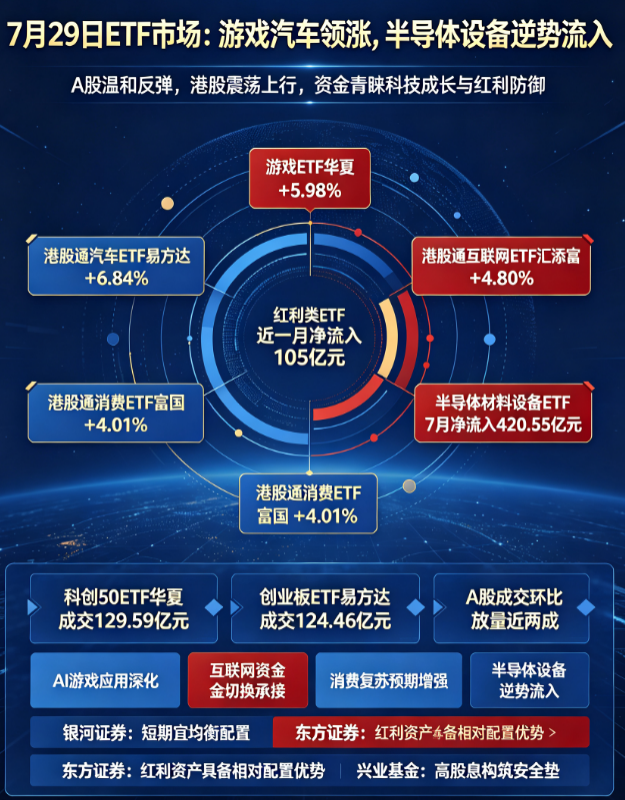
On July 29, the Hong Kong auto sector strengthened across the board, with leading stocks such as Li Auto and Leapmotor up over 8%, making it one of the most eye-catching sectors in the Hong Kong market. Driven by this, the HK Stock Connect Auto ETF (E Fund) surged 6.84% that day, ranking first among all ETFs in market gains. The new energy vehicle industrial chain continues to show strong prosperity, coupled with policy support for intelligent connected vehicles, attracting substantial capital attention to this sector.
Meanwhile, the A-share gaming sector also performed well. The Gaming ETF (China Asset Management) rose 5.98% that day, leading gains among gaming ETFs. Industry insiders believe that with the normalization of game license issuance and the deepening application of AI technology in game development, the gaming industry is ushering in a new round of development opportunities. AI-enabled improvements in content production efficiency and user experience have opened new profit growth spaces for gaming companies.
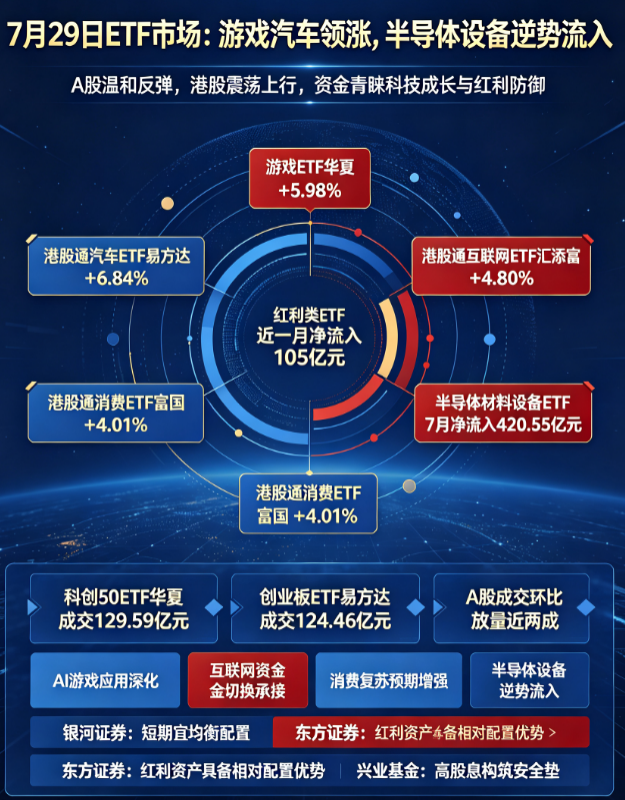
As shown in the above chart, ETFs with the largest gains were mainly concentrated in HK auto, A-share gaming, and HK internet directions. The HK Stock Connect Internet ETF (China Universal) rose 4.80% that day, leading gains among HK internet ETFs. Against the backdrop of some global market capital flowing from AI hardware to software applications, the HK tech sector has become an important receiving direction for capital rotation. In addition, the consumer sector was also actively traded, with the HK Stock Connect Consumer ETF (Fullgoal) up 4.01%, reflecting optimistic expectations for economic recovery and sustained consumption stimulus policies.
In terms of trading activity, A-share market turnover increased by nearly 20% compared to the previous trading day. The STAR 50 ETF (China Asset Management) had a turnover of 129.59 billion yuan, and the ChiNext ETF (E Fund) had 124.46 billion yuan, both exceeding the 100 billion yuan mark, indicating high market attention to tech growth directions.
II. Active Trading in Tech Growth Direction, Contrarian Inflows into Semiconductor Materials & Equipment
Since July, the global stock market's tech mainline has generally experienced a sizable correction, and the A-share semiconductor sector's periodic adjustment has also been significant. However, in stark contrast to the market correction, capital has shown a "contrarian inflow" into semiconductor materials & equipment themed ETFs, making this direction one of the most concentrated areas of recent capital inflows.
Wind data shows that as of July 28, among the top ten products by net capital inflow in the ETF market since July, three are semiconductor materials & equipment themed ETFs, with total net inflows reaching 420.55 billion yuan. Among them, the China AMC STAR 50 Semiconductor Materials & Equipment Thematic ETF has seen net inflows of 230.11 billion yuan since July, ranking first among all semiconductor materials & equipment themed ETFs; the Guotai CSI Semiconductor Materials & Equipment Thematic ETF and the E Fund CSI Semiconductor Materials & Equipment Thematic ETF both saw net inflows exceeding 90 billion yuan.
This contrarian inflow phenomenon reflects market confidence in the domestic substitution logic. Semiconductor materials and equipment are the cornerstone of the semiconductor industry and a key link in achieving technological self-reliance in China. Although the sector is under short-term pressure, in the medium to long term, with the continued expansion of domestic wafer fabs and the acceleration of domestic substitution, the growth certainty of related companies is relatively high. Capital deployment through ETFs reflects a forward-looking judgment on the industry trend.
In terms of broad-based ETFs, significant net capital inflows also occurred. Data shows that since July, the China AMC STAR 50 ETF saw net inflows of 348.45 billion yuan, ranking first among all ETFs; the Huatai-PineBridge CSI 300 ETF and the E Fund ChiNext ETF saw net inflows of 295.13 billion yuan and 293.39 billion yuan respectively, also ranking high on the net inflow list. This indicates that amid market volatility, investors tend to use broad-based ETFs for strategic allocation to capture overall market opportunities.
III. Dividend Assets Favored, Allocation Value Highlighted
Recent global market turbulence and increased volatility in the AI sector have raised the need for capital rebalancing, making dividend assets an important safe-haven allocation. Choice data shows that as of July 26, the top 10 dividend ETFs by net inflow over the past month collectively attracted 105 billion yuan. Analysts believe that from the current perspective, the allocation value of dividend assets is mainly reflected in three aspects:
First, in a low-interest-rate environment, high dividend yields are more attractive relative to risk-free returns. Currently, the dividend yield of dividend indices is generally about 3 percentage points higher than the 10-year government bond yield, with a significant spread. Second, in a volatile market environment, dividend assets that combine high dividends and low volatility can act as a buffer in portfolios, smoothing net value fluctuations. Third, mid-year dividends by listed companies are being intensively distributed. Data from GF Fund shows that as of July 20, 550 A-share listed companies have planned mid-year dividends for 2026, potentially increasing the win rate and long-term holding value of dividend strategies.
Galaxy Securities believes that the current market focuses on the dual verification of policies and earnings, and short-term allocation should be balanced. On one hand, wait for the semi-annual report performance of tech sub-sectors to materialize; on the other hand, seize the repair window for low-value sectors. Orient Securities stated that against a backdrop where risk appetite has not fully expanded and style rotation has intensified, dividend assets have a relative allocation advantage, suggesting adding them as a defensive component in a barbell strategy to optimize portfolio resilience. Xingye Fund pointed out that current tech growth tracks still have high prosperity, but high growth often comes with high volatility. Appropriately allocating dividend assets, using high dividends as a safety cushion and low valuations as a buffer, can smooth portfolio fluctuations in volatile markets.
IV. Market Outlook and Investment Strategy
Overall, the market performance on July 29 showed several characteristics: First, structural trends were significant, with sub-sectors such as HK auto, A-share gaming, and HK internet becoming capital focus points. Second, internal divergence appeared within the tech growth mainline; although the semiconductor materials & equipment sector adjusted in the short term, contrarian inflows indicated medium- to long-term confidence. Third, dividend assets gained appeal in volatile markets, becoming an important defensive tool for portfolios.
Looking ahead, investors can deploy from the following dimensions: First, continue to focus on structural opportunities from AI application implementation, especially in gaming, internet, and other areas benefiting from AI empowerment. Second, in the semiconductor materials & equipment direction, buy on dips to seize the long-term domestic substitution logic. Third, use dividend assets as a ballast in portfolios to cope with market volatility. Overall, amid the interweaving of policy expectations and earnings verification, balanced allocation with both offense and defense is a rational choice to navigate complex markets.
Conclusion
The modest rebound of A-shares and HK stocks on July 29, along with the structural performance of the ETF market, reflects the current dynamic balance of capital between tech growth and dividend assets. The contrarian inflows into semiconductor materials & equipment themed ETFs highlight market recognition of long-term value in hard tech, while the sustained capital attraction to dividend assets reflects a thirst for certain returns in a low-interest-rate environment. At the current juncture, investors should adhere to a long-term perspective, reasonably allocate defensive assets while grasping industry trends, to achieve stable returns.