HBM Inventory Adjustment Signals Emerge: Samsung, SK Hynix ADR Shipments and Price Index Show Divergence
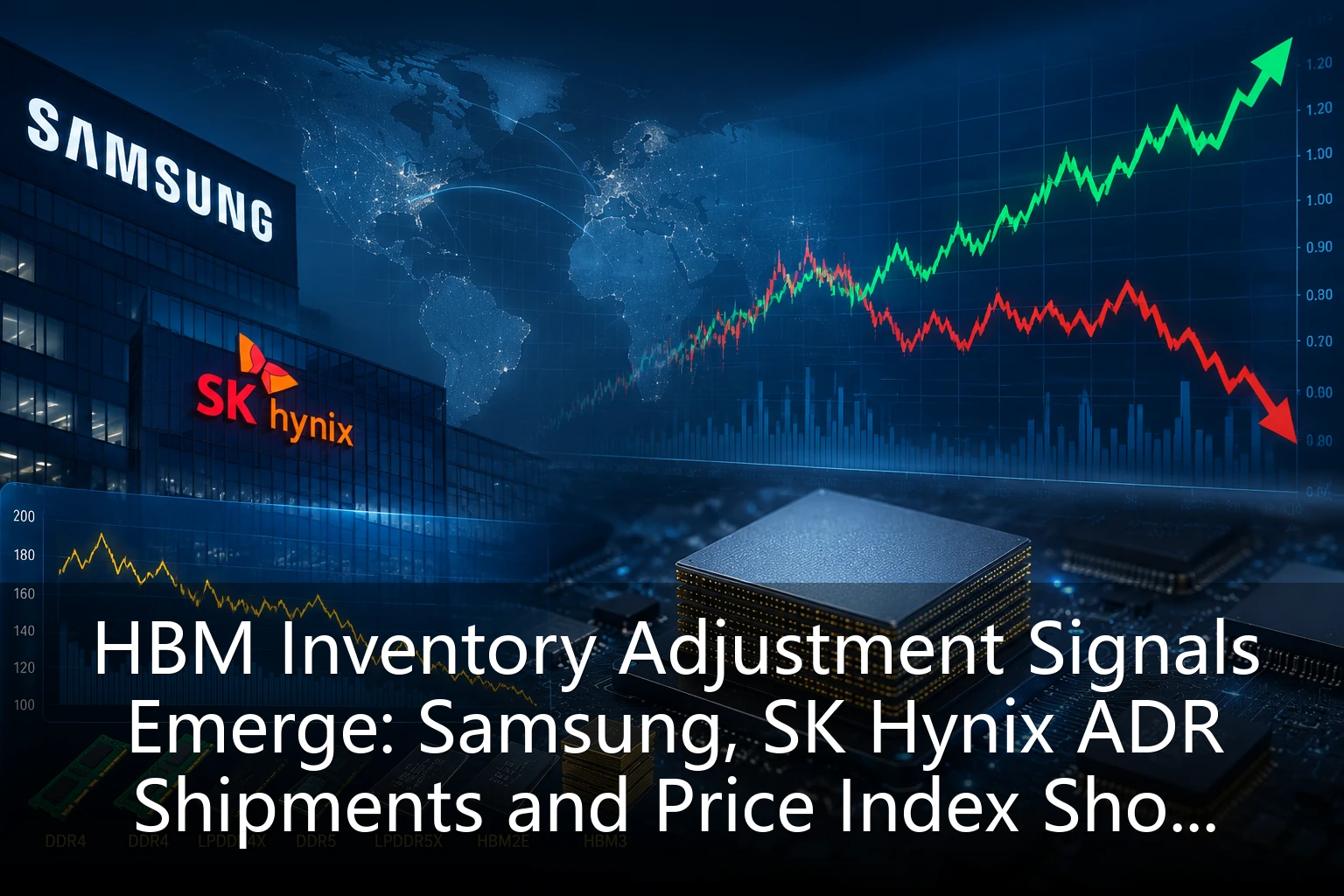
On July 29, 2026, the global memory chip market underwent subtle shifts. As two giants in high-bandwidth memory (HBM), Samsung Electronics and SK Hynix saw notable divergence in their ADR trends on the US stock market. Meanwhile, the latest price index from DRAMeXchange showed weak demand for traditional DRAM, while HBM3E shipments hit new highs but inventory accumulation exceeded expectations, sparking discussions about a near-term supply-demand inflection point.
I. SK Hynix ADR Strengthens Against the Trend, Samsung Electronics Share Price Under Pressure
As of the close on July 28, SK Hynix ADR (ticker: HXSCF) settled at $185.20, up 3.2% from the previous trading day, and hit an all-time high of $187.50 intraday. Analysts attributed the rally to the company's Q2 2026 earnings released last week: revenue grew 68% year-over-year to 18.9 trillion won, with HBM business contribution surpassing 50% for the first time, reaching 52%. SK Hynix also announced that its fifth-generation HBM3E products had successfully passed certification for NVIDIA's next-generation GPUs, expecting shipments to grow 40% sequentially in the second half.
In contrast, Samsung Electronics ADR (ticker: SSNLF) fell 1.8% to $1,420.00, retreating from a recent high of $1,480. Samsung announced this week that it would postpone the production line startup at its US Taylor factory dedicated to HBM to Q1 2027, a six-month delay from the original plan. The market interpreted this as Samsung encountering bottlenecks in HBM yield ramp-up, especially as the gap with competitors in HBM3E failed to narrow quickly. Additionally, Samsung's traditional DRAM business suffered from inventory adjustments, with Q2 DRAM shipments growing only 2% sequentially, below the industry average of 5%.
II. HBM Inventory Accumulation Raises Concerns, Traditional DRAM Prices Remain Weak
The DRAMeXchange price index for memory chips in the third week of July released today shows:
- DDR5 16Gb spot price: down 0.8% week-over-week to $4.55, down 2.1% month-over-month.
- DDR4 8Gb spot price: down 1.2% week-over-week, month-over-month decline widening to 3.5%.
- HBM3E 12-layer stack contract price: up 1.5% sequentially, but growth slowing significantly from 4% last month.
Notably, the overall HBM channel inventory weeks rose from 5.2 weeks to 5.8 weeks, the highest since Q4 2025. Although AI server shipments still maintained sequential growth of over 20%, HBM capacity expansion was faster—combined HBM capital expenditure of Samsung, SK Hynix, and Micron in 2026 exceeded $40 billion, up 55% year-over-year. The short-term oversupply from capacity ramp-up is squeezing the supply share of traditional DRAM for non-AI applications, pressuring PC and mobile DRAM prices.
A report released this week by market research firm TrendForce noted that global DRAM market size grew 8.2% sequentially in Q2 2026, with HBM contributing all incremental growth while traditional DRAM actually shrank 1.5% sequentially. The report lowered its 2026 DRAM price growth forecast from 10%–15% to 5%–10%, citing weaker-than-expected consumer electronics end demand recovery.
III. Fund Flows: AI Storage Themed ETFs See Net Inflows, Stock Divergence Widens
From a fund flow perspective, cross-border investment enthusiasm in the memory chip sector remained strong. In the last week of July, AI storage themed ETFs such as "SOXX" (iShares Semiconductor ETF) and "SMH" (VanEck Semiconductor ETF) saw net inflows of $250 million and $180 million respectively. However, at the individual stock level, fund divergence was notable: SK Hynix ADR had net inflows of $60 million, while Samsung Electronics ADR saw net outflows of $30 million, and Micron (ticker: MU) saw inflows of $40 million due to its HBM3E mass production progress exceeding expectations.
Derivatives linked to memory chips listed on the Singapore Exchange (SGX) traded actively, with futures volume tied to the HBM price index up 35% week-over-week, indicating investors were using derivatives to hedge inventory adjustment risks. Additionally, the amount of cross-border investment by Chinese investors in memory chips via the Stock Connect program has declined recently, possibly due to capital being diverted by the improving sentiment in the A-share semiconductor sector.
IV. Industry Interpretation: Short-Term Inventory Adjustment Does Not Change Long-Term AI Demand
Regarding the current inventory adjustment signals, Wall Street investment banks have diverging views: Morgan Stanley believes "the coexistence of high HBM shipment growth and inventory accumulation means downstream customers are shifting from stockpiling to destocking, expecting HBM prices to face pressure in the next 2–3 quarters." However, Goldman Sachs holds a different view, arguing that "HBM inventory is mainly a transitional phenomenon during capacity ramp-up; with accelerated AI training cluster deployment in the second half, especially the volume ramp-up of H200 and B200 GPUs, HBM demand will once again outpace supply."
From a technology landscape perspective, HBM remains the most certain growth track in memory chips: both Samsung and SK Hynix plan to launch HBM4 products in 2027, with bandwidth expected to increase by over 50% again. Traditional DRAM faces dual pressures of inventory cycles and weak demand; while DDR5 penetration is rising, PC OEM pull-in momentum is insufficient. In NAND flash, enterprise SSD demand remains strong driven by AI storage, but consumer SSD prices are weakening due to smartphone inventory adjustments.
V. Investment Strategy: Focus on HBM Valuation Percentiles and Earnings Catalysts
At present, the valuations of leading US-listed memory chip stocks are at slightly above historical mid-levels: SK Hynix ADR’s P/E (TTM) is about 22x, above the 5-year average of 18x; Samsung Electronics ADR’s P/E is only 11x, near historical lows, but its traditional business drags on near-term earnings. For cross-border investors, the following directions are recommended:
- HBM leaders: SK Hynix is temporarily ahead in HBM technology iteration and customer certification, but its valuation premium is high; attention should be paid to whether future shipments can meet growth expectations.
- AI storage ETFs: ETFs represented by "SMH" and "SOXX" can diversify single stock risk and capture opportunities across the HBM, DRAM, and NAND full industry chain.
- Inventory cycle reversal plays: Samsung and Micron, with high traditional DRAM exposure, may see valuation repair windows if consumer electronics demand recovers in 2027.
- Hedging strategies: Utilize HBM futures or options on SGX and other markets to manage short-term price volatility risks.
Conclusion
The HBM inventory adjustment signal on July 29, 2026 is essentially a microcosm of the memory chip cycle shifting from "broad shortage" to "structural divergence." AI-driven HBM demand remains strong, but the gap between capacity release pace and end-market absorption will continue to dominate the sector's performance over the next two quarters. Investors should closely monitor SK Hynix and Samsung Electronics' monthly shipment data in early August, as well as Micron's fiscal Q4 earnings guidance expected at the end of August, as these will be key to determining the inventory inflection point and stock price direction.