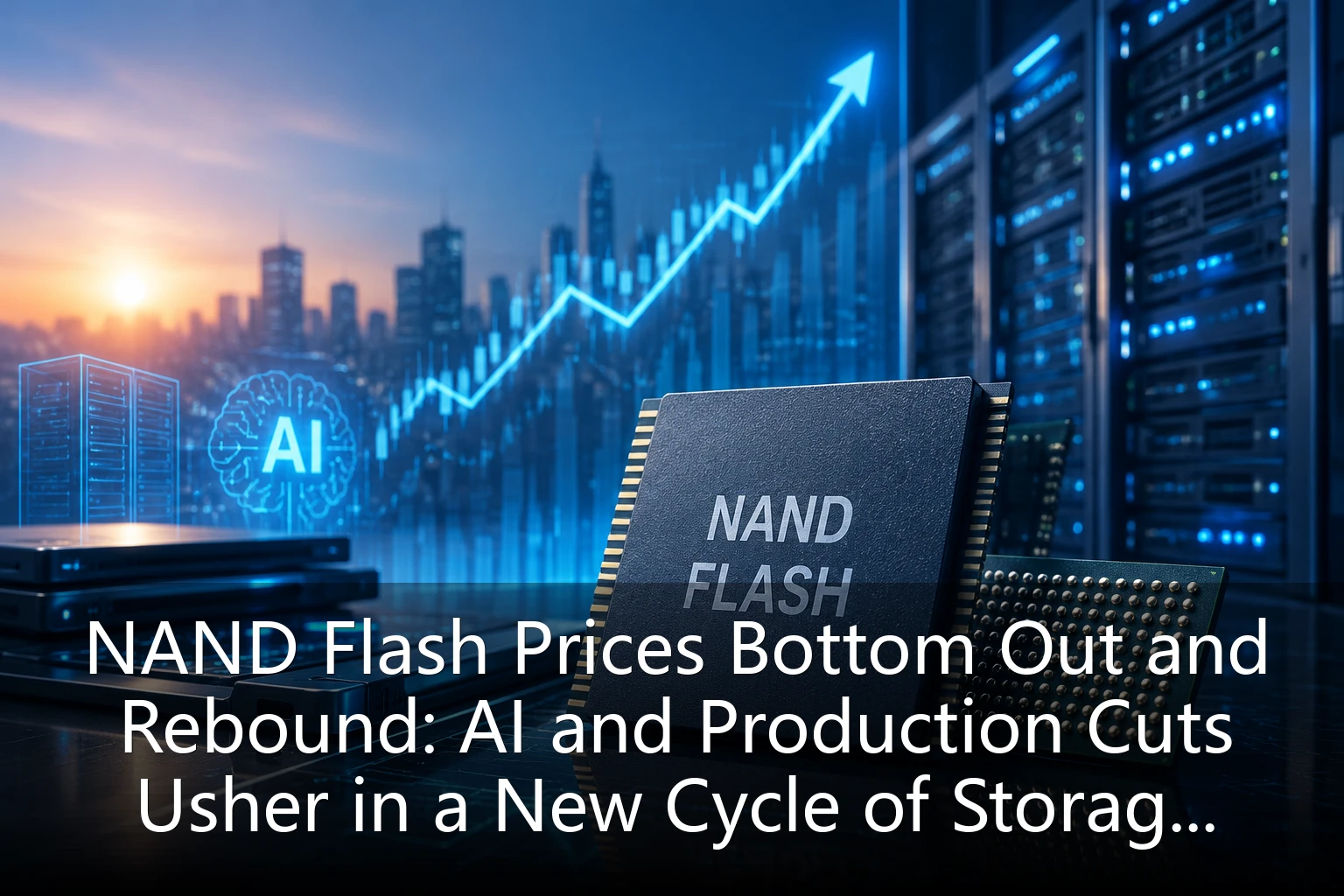
On July 31, 2026, the memory chip market saw a key turning point: after two consecutive quarters of decline, NAND Flash contract prices posted their first sequential recovery this month. According to the latest data from TrendForce, the average contract price of mainstream NAND Flash in July rose about 3% to 5% month over month, with the price increase for 512Gb TLC wafers being even more pronounced. The market widely interprets this change as a sign that the memory cycle is approaching an inflection point, and it has also drawn heightened investor attention to the US-listed ADRs of Asian memory chip makers.
Macro Logic Behind the Price Rebound: AI and Production Cuts Working in Tandem
The recent bottoming out and rebound of NAND prices is not accidental but the result of multiple factors on both the supply and demand sides working together. On the demand side, the demand for storage capacity from AI large-model training and inference is growing exponentially. In particular, enterprise SSDs, as core components for high-bandwidth, low-latency storage in AI servers, have seen their per-server capacity climb rapidly from 4TB to 8TB in the past to over 30TB today. According to IDC, global enterprise SSD shipments will grow 35% year over year in 2026, with AI server-related demand accounting for more than 40% of the total.
On the supply side, manufacturers such as Samsung Electronics, SK Hynix, and Micron Technology have successively launched production cut plans since the fourth quarter of 2025, targeting especially traditional 2D NAND and low-end 3D NAND production lines. After two rounds of cuts, manufacturer inventory levels have dropped from more than 12 weeks in the first quarter of 2026 to around 8 weeks, close to a healthy level. The effect of the production cuts was reflected in July contract prices, and some manufacturers have begun to restore pricing flexibility for high-density products.
Enterprise SSDs Become the New Engine of NAND Demand
Unlike previous cycles driven by consumer electronics, the current recovery in NAND demand relies more heavily on data centers and the enterprise market. AI servers' dependence on storage has shifted from traditional capacity expansion to a coordinated improvement in both performance and capacity. The proliferation of the PCIe Gen5 interface and the penetration of QLC NAND in read-intensive applications have made it possible for single-drive capacity to exceed 64TB. The BiCS8 3D NAND technology jointly released by Western Digital and Kioxia, with 326 layers, further reduces the cost per GB of storage and paves the way for large-scale deployment of enterprise SSDs.
It is worth noting that the persistent shortage of HBM has also squeezed manufacturers' DRAM capacity, prompting some to convert NAND capacity to higher-value HBM-related supporting chips, which indirectly tightens NAND supply. This cross-category linkage has created a subtle positive correlation between NAND prices and HBM market conditions.
Manufacturer Moves and Capex Strategies: From Defense to Offense
With price stabilization signals emerging, the capital expenditure strategies of the three major manufacturers have begun to shift from conservative to aggressive. Samsung Electronics revealed in its second-quarter earnings report released on July 29 that its semiconductor division's capex will be directed toward the Pyeongtaek P4 plant and the Taylor plant, with NAND production lines focusing on products with more than 200 layers to consolidate its leading position in the enterprise market. SK Hynix announced that it will convert part of its NAND plant in Cheongju, South Korea, into dedicated enterprise SSD production lines, and plans to raise its enterprise SSD revenue share to more than 50% of total NAND revenue by 2027.
Although Micron Technology is playing catch-up in HBM, its NAND business is also reaching an inflection point. Company management stated on the earnings call that, due to AI data center customer commitments exceeding expectations, the company has raised its NAND wafer utilization rate by 10 percentage points for the second half of the fiscal year. However, this will not affect overall supply discipline, as the new capacity will be entirely dedicated to high-margin enterprise products.
US ADR Market Reaction and Investment Opportunities
News of NAND price recovery has triggered a chain reaction in the US stock market. As of the close on July 30, Samsung Electronics' US ADR (SSNLF) rose 4.2% for the week, SK Hynix's ADR (HXSCL) rose 5.8%, and Micron Technology (MU) rose 6.1%. Among them, Micron Technology became the focus of capital inflows, thanks to its early positioning in the enterprise SSD market.
In terms of capital flows, the memory chip sector recorded net inflows of $1.23 billion over the past five trading days, the largest weekly inflow in the past three months. This trend is echoed by the heat in call options, with MU's call/put ratio rising to 1.8, near historical highs.
However, some analysts also caution that NAND recovery will not be smooth sailing. Weak consumer electronics demand and capacity expansion by Chinese manufacturer YMTC remain factors pressuring prices. In particular, YMTC has skipped conventional NAND and directly mass-produced 232-layer products, capturing certain niche markets with aggressive pricing.
Outlook: Sustainability and Risks of NAND Recovery
Looking ahead to the second half of the year, the key to NAND price trends lies in the pace of AI demand realization and the execution of manufacturers' production cuts. Some institutions expect NAND contract prices in the third quarter to continue rising 5% to 8% sequentially, with the uptrend likely extending into 2027. However, the market should also be wary of two potential risks: first, if AI server shipments fall short of expectations, manufacturers may face renewed inventory pressure; second, supply chain disruptions caused by geopolitical factors could exacerbate price volatility.
Overall, NAND Flash is standing at the starting point of a new cycle. For investors focusing on the US-listed ADRs of Asian memory chip makers, Samsung Electronics, SK Hynix, and Micron Technology — the three leaders that have established a technological generation gap — remain core targets for capturing industry trends. Module makers and controller chip companies along the enterprise SSD supply chain may also see opportunities for value re-rating.
In the context of capital markets, every NAND price reversal has been accompanied by increased industry concentration and optimized competitive dynamics. This time, AI's catalyst has given the story a new core.