
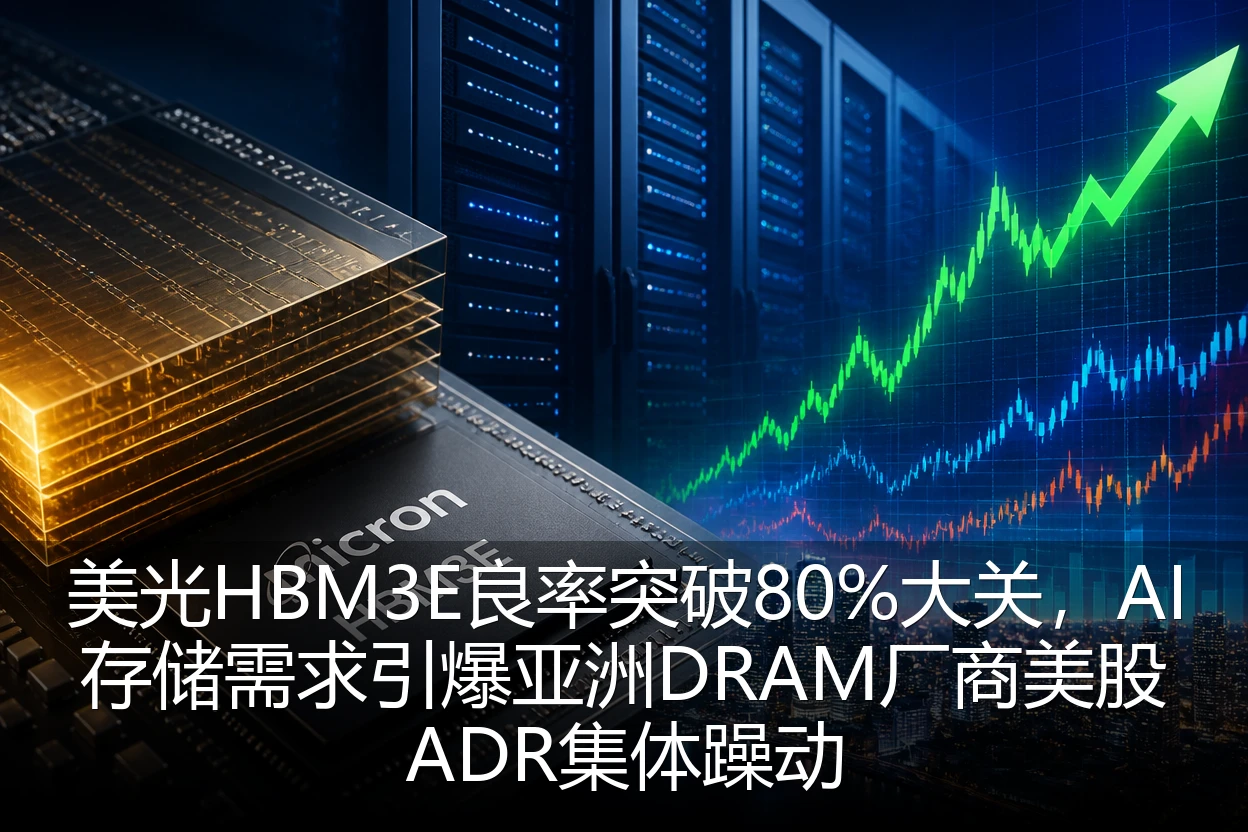
Meiguang Technology announced that its HBM3E high-bandwidth storage chip yield has surpassed 80%, far exceeding the industry expectation of 60-70%, which drove a significant after-hours surge in Meiguang's stock price. This technological leap not only strengthens Meiguang's competitiveness in the AI server storage field but also triggered volatility in the Asian memory chip ADRs, with Samsung and SK Hynix stock prices rising, prompting the market to reassess the HBM supply-demand landscape and t
Breakthrough in Yield: Micron Achieves the "Holy Grail" in HBM Technology Competition
On the first trading day of August 2026, the global memory chip market was ignited by a major technological news item. Micron Technology confirmed in its latest internal technical briefing that the overall yield rate on its HBM3E (fifth-generation high-bandwidth memory) stack, customized for next-generation AI accelerators, has historically surpassed the 80% threshold on the mass production line. This figure far exceeds the 60% to 70% ramp-up yield rate generally anticipated by the industry, signaling that Micron is closing the technological gap in the HBM niche, which has long been dominated by SK hynix.
Stimulated by this news, Micron's stock price surged over 6% in after-hours trading, driving a broad rally in the Asian memory chip ADR sector. As of the time of reporting, SK hynix ADR gained over 4%, and Samsung Electronics ADR rose nearly 3%. The market generally believes that the yield improvement not only means significant optimization in unit wafer costs for Micron but also suggests that the bottleneck in HBM supply is expected to ease sooner, further lowering the deployment threshold for AI servers.
The Capacity Game Behind the Yield: From "Seller's Market" to "New Equilibrium"
For HBM3E chips, which can cost tens of thousands of dollars per unit, yield is the core determinant of a manufacturer's profit margin. Previously, due to the advanced packaging technology involving multi-layer DRAM vertical stacking, including Through Silicon Via (TSV) and micro-bump interconnects, even tiny particle or alignment errors could lead to the scrapping of the entire stack. Therefore, even industry leader SK hynix has maintained an initial HBM3E yield in the 65% to 75% range for a long time.
Micron's announcement of an 80% yield means that the maturity of its 1β process node and the stability of its advanced packaging line have entered a new era. This directly breaks the unilateral market expectation that "HBM will still be severely undersupplied in the second half of 2026." Although the demand for HBM from large AI model training remains ravenous, a substantial increase in output will give downstream cloud service providers (CSPs) a breathing room in negotiations. This explains why, while Micron soared, some market funds began shifting towards downstream compute applications, while the gains in SK hynix and Samsung experienced volatility in intraday trading, reflecting a reassessment of the future price stability of HBM.
Asian Memory Chip ADR Correlation: More Than Just a "Micron Victory"
Micron's breakthrough is not an isolated event; it profoundly disrupts the map of Asian memory chips in the US market. As the global leader in HBM market share, SK hynix's ADR experienced a brief dip due to concerns about intensifying competition before the market open, but it was quickly rallied by buying pressure afterward. The underlying investment logic is that Micron's yield breakthrough validates that the technological pathway from "laboratory samples" to "mass-produced industrial goods" for HBM3E is fully open, which will attract more AI chip design companies to adopt the HBM3E solution, thereby enlarging the entire market pie. For Samsung Electronics, this news appears mixed. Samsung Electronics is currently focusing on overcoming the thermal control challenges in its 1c nm DRAM process on HBM3E, and Micron's report undoubtedly increases pressure on Samsung's internal R&D departments. However, market funds tend to interpret this as further confirmation that the storage chip cycle is fully recovering. Against the backdrop of DRAM and NAND Flash spot prices stabilizing and rising for several months, any positive technical catalyst will translate into confidence in a cyclical reversal.
### Reassessing the DRAM Price Cycle: The Squeeze Effect of HBM
What investors should pay close attention to is that improvements in HBM3E yield will create a complex "squeeze effect" on the traditional DRAM price cycle. Since HBM chips are significantly larger than standard DDR5 chips of the same capacity, and production process compatibility is not 100%, when major manufacturers allocate more wafer capacity to producing high-profit HBM, they are effectively squeezing the supply capacity for standard DRAM.
Micron's yield improvement on HBM means they can produce more qualified HBM die per unit of time, theoretically releasing capacity that would otherwise be consumed by scrapped dies. On the other hand, this might induce Micron to further increase its HBM die loading, exacerbating the contraction in standard DRAM supply. In the Asian market trading on August 2nd, this complex expectation caused a divergence in the stock prices of manufacturers focused on traditional DRAM modules. Market analysts point out that investors need to closely monitor the product mix adjustment strategies of major companies in the third quarter, as the high profit margins of HBM are ushering the general-purpose storage chip industry into a new cycle where "structural shortage" and "technological oversupply" coexist.
## Outlook: AI Storage Enters the Deep Water of the Arms Race
With Micron achieving a milestone victory in HBM3E yield, the AI storage arms race has entered the white-hot phase for the second half of 2026. It is reported that SK Hynix plans to announce the trial production progress of its HBM4 in the near future, while Micron suggests that its HBM4 R&D progress has already surpassed its internal roadmap. For Asian storage chip investors, the simple logic of "price increase to reduce inventory" is failing. Instead, consideration must be given to the speed of technological iteration, the depth of customer lock-in, and the advanced packaging ecosystem.
In the coming weeks, the market will closely watch the quarterly earnings guidance of major storage chip giants. If Micron's yield advantage can successfully translate into actual revenue, it will not only consolidate its leading valuation in the US market but may also trigger a value reassessment wave in the Asian storage chip ADR sector.