HBM4 Enters NVIDIA Ecosystem, SK Hynix ADR Soars After Hours
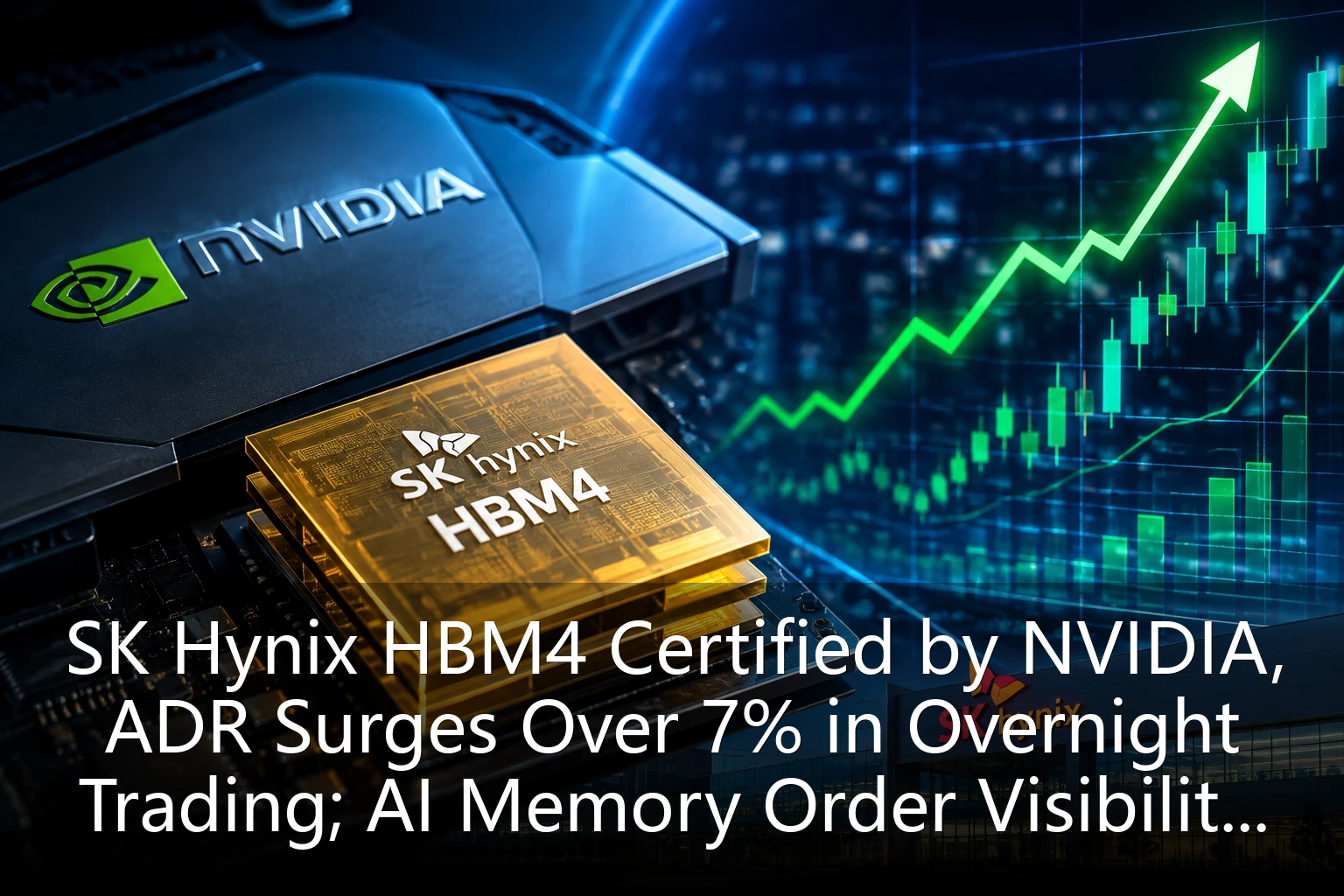
Amid the escalating arms race in artificial intelligence (AI) computing power, global memory chip leader SK Hynix has dropped another bombshell. According to the latest industry news on August 3, 2026, SK Hynix has officially passed NVIDIA's rigorous quality certification for its sixth-generation high-bandwidth memory (HBM4). This critical milestone means SK Hynix's HBM4 product has secured the world's largest AI chip buyer and will be integrated into NVIDIA's highly anticipated next-generation Blackwell architecture GPU platform.
Directly catalyzed by this news, SK Hynix's ADR (American Depositary Receipt) experienced a sharp surge in after-hours and overnight trading, with the stock price skyrocketing over 7% at one point and trading volume expanding dramatically. This movement not only reflects market recognition of SK Hynix's technological moat but also highlights the extremely high strategic value of HBM as a core bottleneck in the AI computing era.
Technological Leap: Seamless Transition from HBM3E to HBM4
Compared to the current mainstream HBM3E, HBM4 represents another revolutionary leap in memory bandwidth and energy efficiency. According to industry analysis reports, the single-stack bandwidth of SK Hynix's HBM4 samples is expected to exceed 1.6TB/s, a roughly 40% improvement over the previous generation, while power efficiency is optimized by over 25%. This is crucial for NVIDIA's Blackwell GPUs (such as the B200 series), which are already approaching power consumption limits.
Notably, the speed of this certification far exceeded market expectations. Just weeks ago, the market was still discussing yield ramp-up issues for 12-layer stacked HBM3E products, yet SK Hynix has rapidly advanced its front to HBM4. This indicates the company has achieved decisive breakthroughs in MR-MUF (Mass Reflow Molded Underfill) and subsequent hybrid bonding technologies. For NVIDIA, securing SK Hynix's HBM4 capacity is a core prerequisite for the on-time delivery of its Blackwell Ultra and next-generation Rubin architecture.
Extended Order Visibility: 2027 Capacity Already Fully Booked
This certification is not only a technical victory but also a substantial commercial guarantee. According to sources familiar with the supply chain, following the HBM4 certification, NVIDIA has placed significant additional long-term orders with SK Hynix. Currently, not only is SK Hynix's entire 2025 HBM capacity sold out, but its mixed HBM3E and HBM4 capacity for 2026 has also been fully allocated. Even a portion of its HBM4 capacity for the first half of 2027 has already been locked in by major cloud service providers (CSPs) and AI enterprises.
This 'pre-sale' business model fundamentally alters the traditional cyclical fluctuations of memory chips. In the past, memory chip prices were heavily influenced by supply and demand dynamics. Now, the customized, high-value-added nature of HBM decouples it from the cyclical patterns of standard DRAM, transforming it into a long-term contract model similar to wafer foundry services. This provides SK Hynix with extremely high revenue visibility and stable margin expectations. Consequently, analysts have broadly raised their earnings per share (EPS) forecasts for SK Hynix for 2026-2027, predicting its operating margin could exceed 40% driven by HBM.
Samsung in Hot Pursuit, Intensifying HBM Duopoly
While SK Hynix advances aggressively, another Asian memory giant, Samsung Electronics, is also sprinting in the HBM4 race. Although Samsung has recently been weighed down by inventory adjustment pressures in its traditional DRAM and NAND businesses, leading to relatively sluggish performance in its US ADR, it is attempting to overtake in the HBM field through a 'one-stop' foundry and memory service (Turn-Key Service). Reports indicate Samsung is actively sampling HBM4 to NVIDIA and several North American cloud service providers, emphasizing its integration advantages in 2.5D/3D packaging.
However, SK Hynix's achievement of being the first to obtain Blackwell certification undoubtedly gives it a first-mover advantage in the time window. For investors, the HBM4 competition has entered an early 'winner-takes-all' phase. Whoever secures the primary supplier position for NVIDIA's next-generation architecture will control pricing power in the future AI memory market. Currently, SK Hynix, leveraging its first-mover advantage in HBM4, continues to maintain a leading market share position over Samsung in the HBM segment.
Bullish Market Sentiment: Asian Memory Chip ADRs Rise in Sympathy
The strong performance of SK Hynix's ADR also fueled optimism across the entire Asian memory chip sector in the US stock market. In overnight trading, although Samsung Electronics' ADR did not yet see a synchronous surge, buying interest was notably active. Meanwhile, due to the increased packaging complexity of HBM4, related advanced packaging equipment and material stocks also experienced sympathetic gains in the US market.
For investors, the investment logic for memory chips has become highly divergent. Traditional DRAM prices remain in a bottoming phase, but the HBM track is showing a boom characterized by supply falling short of demand. SK Hynix's HBM4 certification undoubtedly injects a strong dose of confidence into AI memory demand, indicating that from the second half of 2026 into 2027, the thirst for memory bandwidth driven by AI computing power is not slowing down but accelerating in its iteration. With the large-scale rollout of the Blackwell architecture, HBM4 is poised to become the core engine driving both the performance and stock price explosion of Asian memory chip leaders, following in the footsteps of HBM3E.