Samsung Electronics Q2 Profit Soars 420%: HBM3E Becomes the Strongest Engine
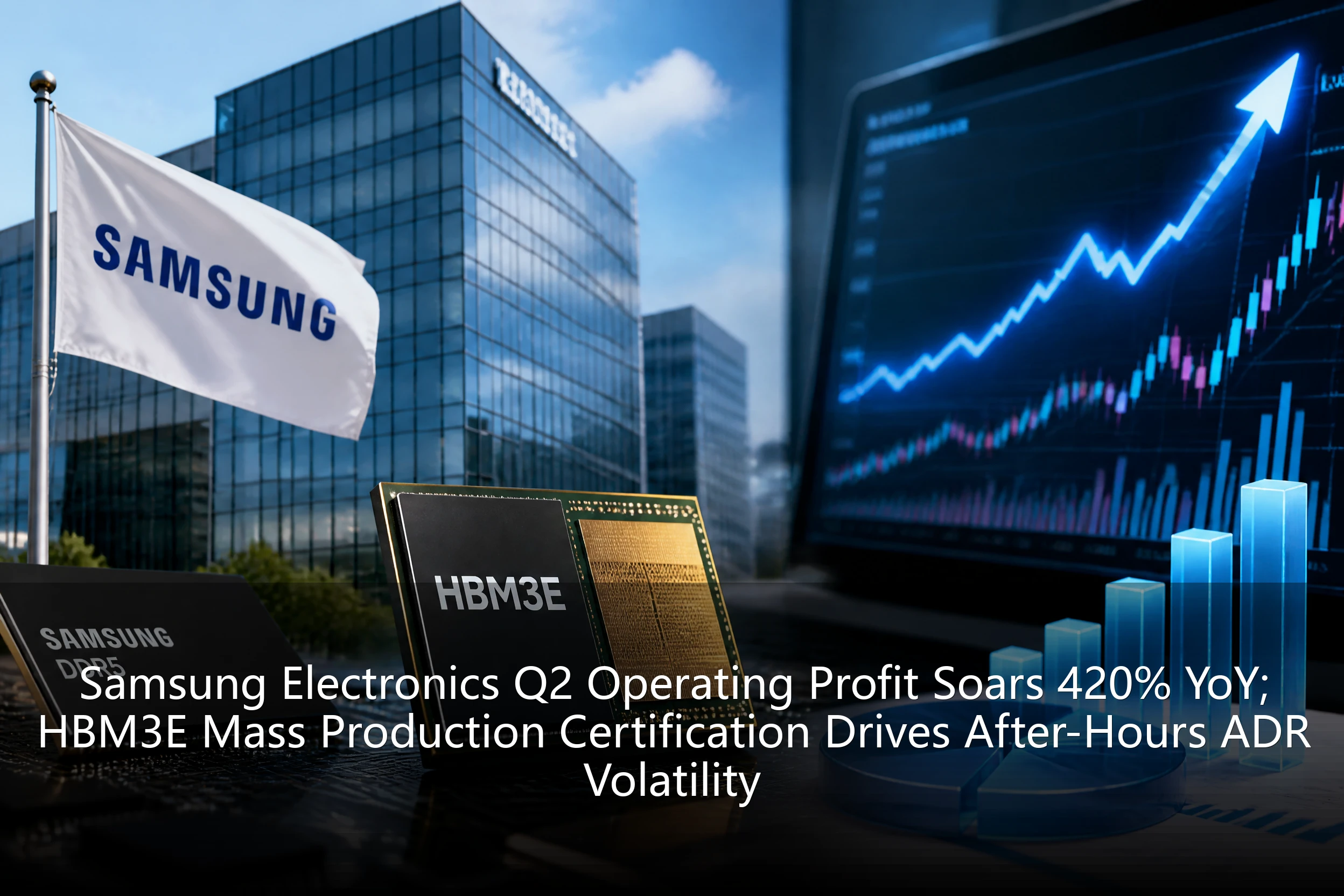
On August 4, 2026, global memory chip giant Samsung Electronics officially announced its Q2 2026 earnings. Data showed Samsung achieved an operating profit of approximately 14.8 trillion Korean won (about $10.5 billion), a staggering 420% surge from 2.84 trillion won a year earlier, marking its highest quarterly profit since Q4 2022. This result significantly exceeded the consensus analyst estimate of 13.2 trillion won, with core drivers being the production ramp-up of HBM3E (5th generation High Bandwidth Memory) and sustained DRAM price strength supported by AI demand.
Following the release, Samsung Electronics' US-listed ADR (SSNGY) experienced notable volatility in after-hours trading, surging over 4.5% at one point with trading volume more than doubling its daily average. SK Hynix ADR (HXSCL) also rose in sympathy, driven by sector sentiment, with the overall Asian memory chip US-listed sector seeing net capital inflows.
HBM3E Production Ramp-Up: Memory Division Contributes Nearly 70% of Profit
By business segment, the Memory Chip division (DS Division) was the absolute protagonist of this earnings report. The division posted an operating profit of about 10.2 trillion won in Q2, accounting for 69% of the company's total operating profit, a dramatic turnaround from a loss in the same period last year. Samsung disclosed during its earnings call that HBM3E product line revenue grew over 65% quarter-on-quarter, with shipments doubling from Q1, primarily to major AI computing chip giants like NVIDIA and AMD.
Notably, Samsung's management publicly confirmed for the first time that its 12-layer HBM3E stacked product had passed full certification with NVIDIA in Q2 and began mass shipments in July. This progress marks a milestone for Samsung in catching up with SK Hynix in the HBM race. Previously, SK Hynix dominated the AI memory market with its HBM3E lead; Samsung's certification now reinforces a duopolistic competitive landscape in the HBM market.
DRAM Price Cycle: AI Server Demand Offsets Weakness in Traditional Consumer Electronics
Another key focus of Samsung's Q2 earnings was the direction of the DRAM price cycle. According to the report, the average selling price (ASP) of DRAM rose about 12% quarter-on-quarter in Q2, with server DRAM prices increasing over 15%, while PC and smartphone DRAM saw only low single-digit gains. This divergence clearly indicates that robust demand for high-capacity, high-bandwidth DRAM from AI servers is effectively offsetting inventory adjustment pressures in the traditional consumer electronics memory market.
Market research firm TrendForce noted in an August 3 report that DRAM contract prices are expected to rise another 5% to 10% in Q3 2026, with HBM categories potentially exceeding 15%. However, the firm also warned that the NAND flash market faces pressure from weak consumer SSD demand, potentially leading to high-level price volatility. Samsung acknowledged during its conference call that its NAND business profitability dipped slightly in Q2 compared to Q1, mainly due to a slowdown in enterprise SSD shipment growth.
Capital Expenditure and Capacity Expansion: P4 Fab HBM Dedicated Line Nears Operation
Regarding capacity layout, Samsung disclosed several key developments. The company's dedicated HBM3E production line at its P4 fab in Pyeongtaek, South Korea, officially began operations at the end of July, with an initial monthly capacity of about 15,000 wafers, planned to increase to 30,000 by the end of 2026. Simultaneously, Samsung reiterated its previously market-stirring plan to potentially locate an HBM4 production line in Austin, Texas, USA, stating that a feasibility assessment is underway, with a final decision expected in early 2027.
This pace of capacity expansion has profound implications for the global memory chip supply-demand balance. Analysts note that the capital expenditure race between Samsung and SK Hynix in the HBM field could lead to an oversupply risk in HBM by the second half of 2027. In the short term, however, robust demand for HBM from large AI model training will continue to support high prices.
Market Sentiment and Capital Flows: Asian Memory Chip ADRs See Foreign Capital Replenishment
Samsung's strong earnings performance significantly boosted overall sentiment for Asian memory chip US-listed ADRs. Data showed notable capital inflows into index ETFs tracking Asian semiconductor US-listed ADRs (such as the Asian memory components within SOXX) during the late Asian trading session on August 4. Previously, due to concerns over HBM inventory adjustments, Asian memory chip ADRs experienced a wave of profit-taking in late July, with both Samsung and SK Hynix ADR prices falling about 8% to 10% from their historical highs.
Analysts believe Samsung's Q2 earnings effectively alleviated market fears of peak HBM demand, but attention must be paid to NVIDIA's late-August earnings guidance on AI capital expenditure, which will be a key variable determining the subsequent trajectory of memory chip ADRs.
Investment Implications: Focus on HBM Competitive Landscape and DRAM Cycle Inflection Point
In summary, Samsung Electronics' Q2 2026 earnings convey several key signals: First, the HBM3E production ramp-up is becoming the strongest engine for profit growth, a trend expected to continue into 2027. Second, the DRAM price cycle, structurally supported by AI server demand, will remain firm in the short term, but caution is needed regarding the spillover effect of consumer electronics weakness on the NAND market. Finally, the HBM capacity race between Samsung and SK Hynix could become the biggest variable for the memory chip industry's supply-demand balance in 2027.
For investors, the core trading logic for the current Asian memory chip US-listed ADR sector revolves around two main themes: "HBM supply-demand" and the "DRAM price cycle." Close attention is recommended to NVIDIA's earnings guidance, HBM capacity expansion progress, and monthly DRAM contract price data, as these indicators will be key to judging whether sector valuations are reasonable.